
Six artists, many ways of seeing
The collection brings together Chen Wen Hsi, Cheong Soo Pieng, Ang Ah Tee, Lim Tze Peng, Ong Kim Seng and Tan Choh Tee, in media ranging from Chinese ink and watercolour to acrylic and oil. Its subjects vary just as widely, from a large-scale painting of squirrels by Chen, formerly in Dr Earl Lu’s collection, to a Nanyang scroll by Cheong depicting Taiwanese subjects. Yet one subject keeps returning: Singapore, in its streets, waterways and changing urban landscape, from Chinatown to the Singapore River.
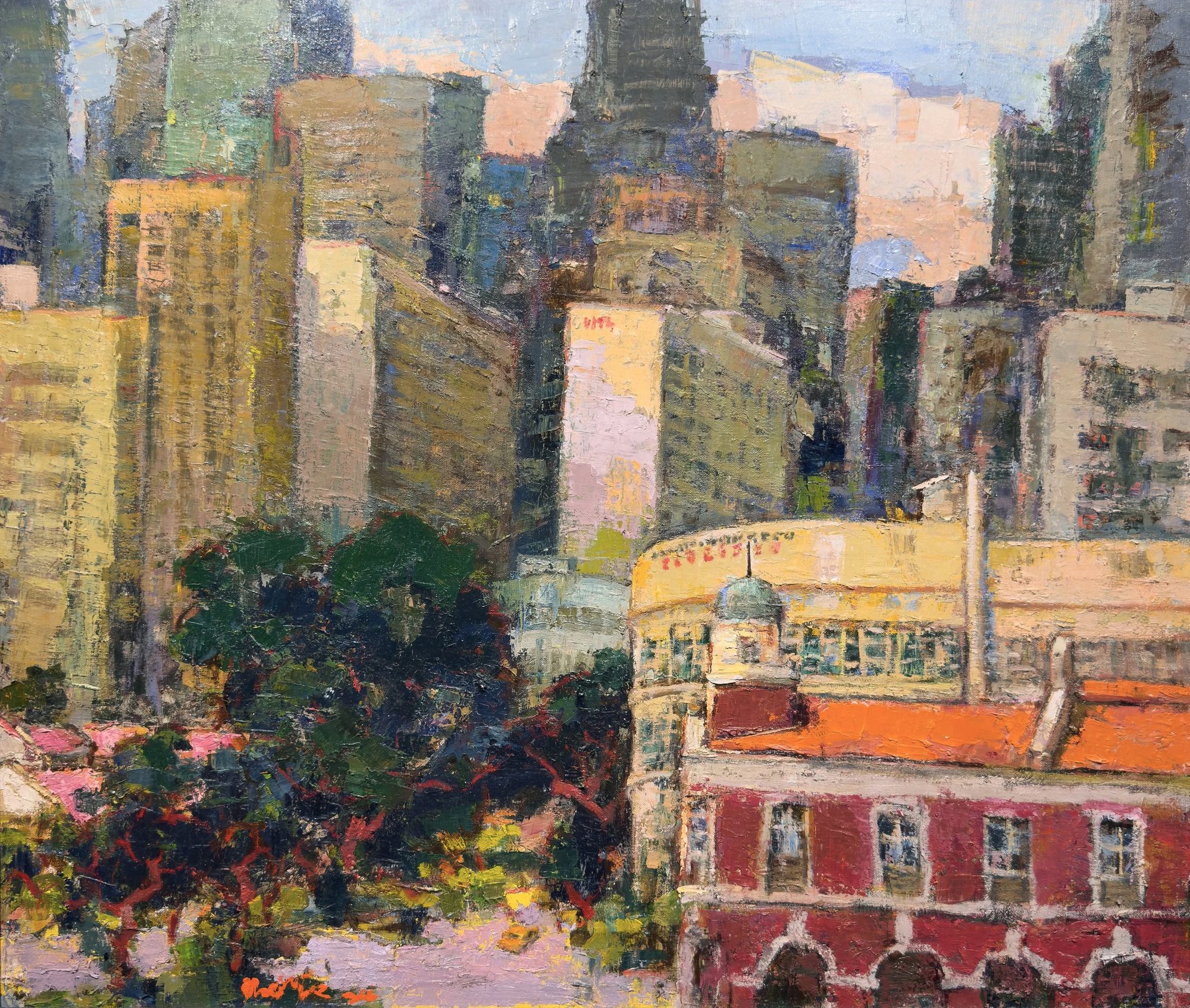
A particular focus: Tan Choh Tee
Tan Choh Tee receives particular emphasis, reflecting the collector’s admiration for his distinctive engagement with landscape and place. His Singapore works span historic streetscapes to expansive cityscapes that record the city’s changing character.
Beyond Singapore, the collection also encompasses his views of Phuket and other locations across Southeast Asia, Europe and China.
His works are grouped by place in the collection: Singapore, China, Paris, Southeast Asia and Germany.
Care and purpose
To bring a work into a collection is to take on its care, study and preservation. No collection can encompass an entire artistic tradition, and this one is a single considered selection from a wider field.
Its aim is to investigate, preserve and share these works so their histories, artistic significance and cultural contributions can inform future research and appreciation.
Each work has its own catalogue entry, exploring its composition, colour, technique, provenance and context.
Why “Axía”?
Axía comes from the Greek ἀξία, meaning worth, value and merit. The name also alludes to the Axiom of Choice in set theory, a nod to the collector’s career as a mathematics educator. Both ideas converge in the act of selecting from a vast field of possibilities, where no particular choice is predetermined. In collecting, that choice is guided by knowledge, experience and the cultivated discernment through which artistic worth is recognised.
The mark
Like the name, the mark draws on both Greek and mathematics. It is an upper-case Greek phi (Φ), a letter that carries meaning in mathematics and in philosophy.
- W, oval width: across the oval, from its left edge to its right edge
- H, oval height: down the oval, from its top edge to its bottom edge
- S, stroke length: the vertical stroke, from its top bar to its bottom bar
- W ÷ H = φ ≈ 1.618, and S = W
In mathematics, phi (φ) denotes the golden ratio, approximately 1.618, in which the whole is to the larger part as the larger part is to the smaller. Long associated with proportion and aesthetic harmony, it has featured in discussions of art and architecture. For a collector with a background in mathematics education, it also carries a personal significance. The mark is constructed according to this proportion: the oval is φ times wider than it is tall, while the vertical stroke is φ times the height of the oval it crosses, making the stroke equal in length to the oval's width.
In philosophy, φ is commonly used as a placeholder for an action. When philosophers ask what someone ought to do, or what reasons they have to act, they speak of reasons to φ, or whether one ought to φ. The symbol is also the initial letter of φιλοσοφία, meaning the love of wisdom — an enduring pursuit of knowledge, understanding and deeper insight. Here, φ evokes the relationship between choice and action, reflecting the act of selection that gives The Axía of Choice its meaning.
Look closely, and the mark also reveals an eye: the oval, crossed by the vertical stroke and centred on a small ring, becomes the discerning eye of the collector at work.
Enquiries and credits
Research, loan, image, media or any enquiries:
All rights reserved. No part of this website may be reproduced, distributed, or transmitted in any form or by any means, including photocopying, recording, or other electronic or mechanical methods, without the prior written permission of The Axía of Choice.